Skip to content
For travelers looking to discover a less-traveled side of Peru, some places only reveal themselves when you venture beyond the usual routes. Taqrachullo, in the province of Espinar, is one of them.
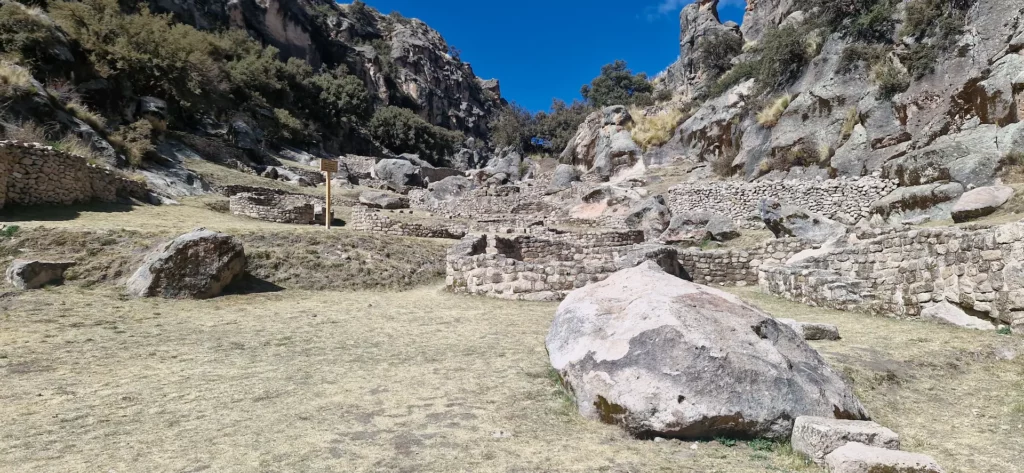
Set at around 4,100 meters above sea level, this archaeological complex brings together more than 100 restored enclosures, ancient defensive walls, and funerary chullpas linked to the Cana and Inca cultures. Its setting is a big part of the appeal: from the upper reaches of the site, the landscape opens toward deep canyons and the point where the Apurímac, Callumani, and Cerritambo rivers meet.
But reaching Taqrachullo is also about discovering the route that leads there. From Cusco, the journey crosses the Vilcanota Valley, the sweeping highland plains of Espinar, and some of the most distinctive geological landscapes in this part of the Andes.
At Metropolitan Touring, exploration is central to how we get to know a destination. Our teams carry out scouting trips to different corners of Peru, uncovering new places, understanding their surroundings, and continually broadening our perspective of the country. Taqrachullo is one of those places that makes us wonder what other treasures still lie beyond Peru’s best-known routes.
The Journey from Cusco to Taqrachullo
The drive from Cusco to Taqrachullo takes roughly 5 hours and 30 minutes each way, and along the route the scenery shifts from the Vilcanota Valley to the broad highland plains of Espinar and some of the most striking landscapes of the southern Andes. The road follows the Southern Longitudinal Highway and passes through towns such as Andahuaylillas, Urcos, and Sicuani. During the first stretch, it winds through inter-Andean valleys and agricultural areas before the vegetation gradually changes and the mountains give way to a vast plateau blanketed in ichu grass.
Alpacas, llamas, and sheep are a common sight across these highland plains, while the mountains stretch toward an ever-widening horizon. Because of the distance, Taqrachullo makes the most sense as part of a broader route through southern Peru, where the road itself—and the places you encounter along the way—become part of the experience.
The Espinar Stop
About 226 kilometers south of Cusco, the town of Espinar provides a natural place to pause before continuing to Taqrachullo. Sitting at roughly 3,928 meters above sea level, it offers a welcome chance to stop for breakfast and rest before the final stretch.
From Espinar, it is about 40 kilometers to the archaeological complex, a drive of approximately one hour. Here, the paved road gives way to an unpaved section, though some areas are currently undergoing improvement works that will help enhance access to the region in the future. From this point onward, the landscape grows increasingly distinctive, with wide expanses of ichu, dramatic rock formations, and mountains accompanying the road toward Taqrachullo.

Landscapes Along the Way
The journey to Taqrachullo includes several points of interest that make the drive far more than a simple transfer.
Apachaco Colonial Bridge (Machu Puente)
One of the highlights along the route is the Apachaco Colonial Bridge, also known as Machu Puente. Built during the colonial period over the Apurímac River, this stone bridge stands out for both its architecture and the striking contrast it creates with the surrounding highland scenery. Its presence is a reminder of the historical importance of these routes and adds a cultural dimension to the journey before reaching the archaeological complex.
The Three Canyons
Further along, the landscape changes noticeably. The Three Canyons take their name from the confluence of the Apurímac, Callumani, and Cerritambo rivers, whose waters meet among towering volcanic rock formations, some rising more than 80 meters.
After crossing a broad highland plateau, the contrast is striking. The open plains give way to soaring rock walls that increasingly dominate the view, creating one of the most distinctive natural settings in Espinar and one of the highlights of the route to Taqrachullo.

Devil’s Gorge
Devil’s Gorge offers another perspective on the region’s dramatic geology, where the Apurímac River narrows as it forces its way between rock formations, creating a natural gorge sculpted over time. Together with the Three Canyons, this formation offers a glimpse into the geological forces that have shaped Espinar and makes the journey to Taqrachullo an experience in its own right.
The Archaeological Site of Taqrachullo
After crossing the highland plains and canyons, the road eventually reaches the base of Taqrachullo, which stands at approximately 4,100 meters above sea level atop a volcanic formation. Its location allows visitors to appreciate how the archaeological structures blend into the area’s natural topography. Associated with the Cana and Inca cultures, Taqrachullo preserves a range of features that offer insight into the occupation of this part of the Andes.

The Ascent Hike
Reaching the complex requires an uphill walk of roughly 35 to 45 minutes along a trail fitted with stone steps and railings. While the route is not technically difficult, the altitude makes the ascent more demanding, so at 4,100 meters above sea level, proper acclimatization and a steady pace are key to enjoying the walk. Once at the top, the first archaeological structures come into view alongside the canyons that surround the site.
An Ancient Fortress in the Highlands
The perimeter defensive walls are among the most notable features of Taqrachullo, reinforcing its character as a fortified settlement. Within the complex are more than 100 restored circular and rectangular enclosures, believed to have served residential and storage purposes. The scale of the site makes it clear that Taqrachullo is far more than an isolated monument; it is an extensive archaeological complex shaped around the mountain’s natural topography.
Funerary Chullpas
Among the site’s notable features are stone funerary chullpas associated with the Cana and Inca cultures. These structures reflect the importance of funerary and ceremonial practices within Andean societies and add another layer to the history of the site. Together with the enclosures and defensive walls, they offer a glimpse into the different functions Taqrachullo served throughout its occupation.
Practical Tips for Your Visit
Because of its location and altitude, a visit to Taqrachullo takes some planning.
- Plan your journey ahead. From Cusco, the drive takes roughly 5 hours and 30 minutes each way. For this reason, the site is better suited to a broader route through southern Peru than to a conventional day trip from Cusco.
- Start early. An early departure gives you more time to enjoy the route and make the most of the stops and landscapes along the way.
- Bring warm clothing and layers. Conditions can change quickly in the high Andes, and a windproof jacket is particularly useful.
- Protect yourself from the sun. At more than 4,000 meters above sea level, solar radiation can be intense, so pack a hat, sunglasses, and sunscreen.
- Carry water and snacks. Services are limited during the final stretch of the journey.
- Wear comfortable footwear. Reaching the complex involves a 35- to 45-minute walk along paths and stone steps.
- Consider the altitude. Proper acclimatization is especially important before undertaking the ascent.
A New Perspective on the Andes
Taqrachullo is not simply a place to visit an archaeological site; the journey itself is part of the story. The route from Cusco crosses the Vilcanota Valley, the highland plains of Espinar, and landscapes where the Apurímac begins to carve its way through enormous volcanic rock formations. The final ascent leads to a complex with more than 100 restored enclosures, defensive structures, and funerary chullpas.
Then, from the Three Canyons Viewpoint, everything comes together in a single panorama: archaeological heritage, mountains, rivers, and the vast scale of the Andes. For travelers eager to discover a Peru that lies beyond the most frequently visited routes, Taqrachullo offers a fresh perspective on the southern Andes. Exploring Peru also means looking beyond the familiar—beyond the destinations we already know, toward roads still to follow, landscapes still to discover, and places that reveal a different side of a country that always has something new to offer.