What you need to know: The Galapagos Islands are located about 600 miles off the coast of Ecuador in the Pacific Ocean. The archipelago, made up of 19 islands and dozens of islets, is part of Ecuador, and more than 97% of its land area is protected as Galapagos National Park. Because the islands belong to Ecuador, there’s no way to fly to the Galapagos directly from outside the country — every itinerary routes through mainland Ecuador first, typically via Quito or Guayaquil.
Travelers often ask how long it takes to get to the Galapagos door to door, and the honest answer is that it depends heavily on where you’re starting. From North America, combined flight and airport time often falls around 10 to 14 hours, while from Europe it’s wise to plan for 16 hours or more. In practice, many itineraries also include an overnight on mainland Ecuador, which means the journey usually unfolds over two days rather than in one continuous travel stretch.
How to Get to Galapagos: The Complete Guide
Here are the general steps to follow if you’re traveling from outside the country.
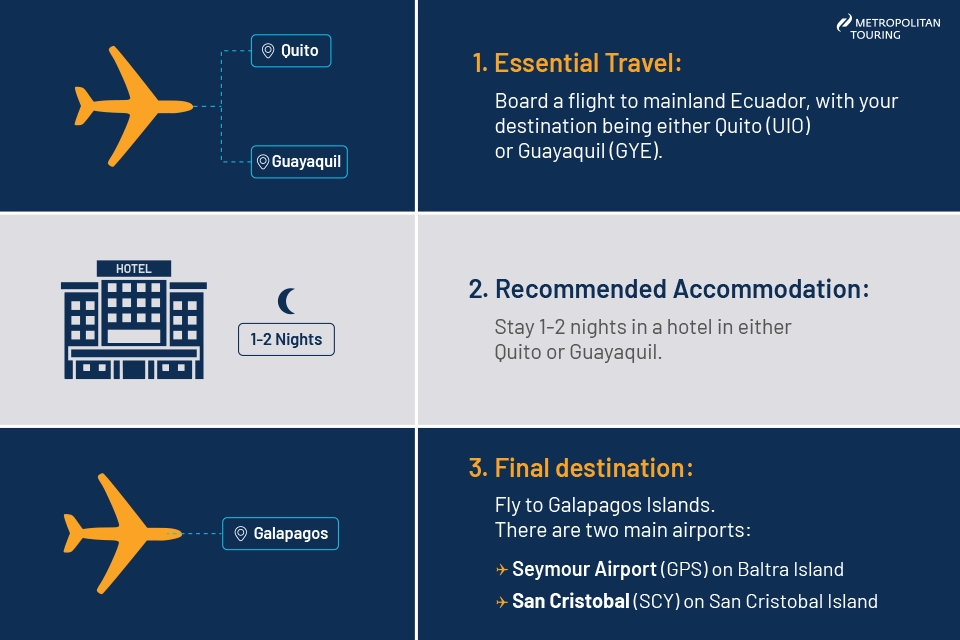
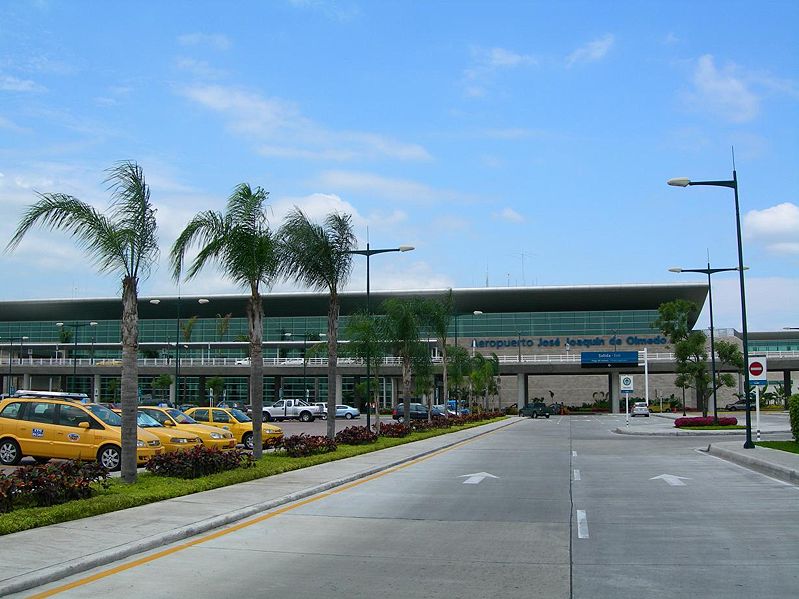
There are no direct international flights to the Galapagos, so every trip starts on the Ecuadorian mainland. You’ll first need to fly into one of two international airports: Quito’s Mariscal Sucre International Airport or Guayaquil’s José Joaquín de Olmedo International Airport. From there, you’ll need to spend the night and prepare to fly out the next morning, since Galapagos-bound flights depart early and don’t connect same-day from most international arrivals.
The next morning, you’ll catch a domestic flight to one of the two Galapagos airports: Seymour (on Baltra Island, near Santa Cruz) or San Cristobal. Flights from Guayaquil take about 1 hour and 40 minutes, while flights from Quito run around 2.5 hours, including a brief stop in Guayaquil. Before boarding, you’ll pass through a mandatory biosecurity inspection and purchase a Transit Control Card (TCT), both designed to protect the islands’ ecosystem. Upon arrival in the Galapagos, you’ll pay the National Park entrance fee — currently around $200 for most foreign adults — in cash.
From the airport, a short bus and ferry connection (if you’ve landed at Baltra) or a short walk (if you’ve landed at San Cristobal) gets you into town or to your waiting cruise. From North America, the journey often involves 10 to 14 hours of combined flight and airport time; from Europe, 16 hours or more is common, depending on connections and point of origin. In practice, many itineraries also include an overnight on mainland Ecuador, so the trip usually unfolds over two days rather than as one continuous journey. For many travelers, that overnight also offers the added benefit of time to enjoy Quito before continuing on to the islands.
Booking through a tour operator like Metropolitan Touring can simplify this considerably, since flights, hotel stays, and transfers are coordinated for you. But even if you’re planning independently, the process above is the same one every visitor follows, regardless of nationality or itinerary. The sections below go step by step into each part of that journey.
Why Every Trip to Galapagos Goes Through Mainland Ecuador
The Galapagos Islands don’t have any direct international flights, and that’s by design. Because the islands are a UNESCO World Heritage Site and one of the most fragile ecosystems on the planet, the Ecuadorian government tightly controls who enters and how. Every visitor’s path to Galapagos runs through the mainland, where flights, luggage, and even fresh produce are inspected before departure.
This is also the answer to a question a lot of travelers ask when they’re first researching how to get to Galapagos from Ecuador: there’s simply no way around the mainland layover. Routing everyone through Quito or Guayaquil lets park authorities track arrivals, collect the required fees, and screen for invasive species that could threaten native wildlife. It adds a step to the trip, but it’s a step worth understanding before you book.
How to Get to the Galapagos Islands from Quito and Guayaquil
Both Quito and Guayaquil offer daily flights to the Galapagos, typically departing in the morning to align with the islands’ airport operating hours. Flight time from Guayaquil runs about an hour and forty minutes, while flights from Quito take closer to two and a half hours, often with a brief technical stop in Guayaquil to pick up additional passengers.
If you’re wondering the most efficient way to fly from Quito to the Galapagos, the short answer is: book a flight that departs Quito early enough to make that Guayaquil stop without cutting it close on connection time. In practice, figuring out how to get to Galapagos from Quito versus from Guayaquil comes down to your own itinerary and how much flexibility you want on either end. Guayaquil, being closer to the islands and at sea level, tends to offer slightly more flight options and marginally lower fares, which is why many travelers choose to overnight there instead of Quito. That said, if your international flight lands in Quito and you’d rather not backtrack, flying direct from the capital is entirely workable — you’ll just want to build in a buffer.
Essential Tips & Baggage Allowance for Getting to the Galapagos
A few practical details make a real difference once you’ve sorted out your flights to the Galapagos and are getting ready to travel. Baggage allowances on flights to the islands are stricter than standard domestic routes — most airlines cap checked luggage at approximately 44 pounds (20 kilograms) per person, with additional weight subject to a per-kilogram fee at the airport. Pack light and consider a soft-sided duffel rather than a hard-shell suitcase, since space on smaller aircraft and inter-island boats is limited.
Arrive at the airport at least two to three hours before your flight. Between the mandatory biosecurity inspection, the fee payment counters, and standard check-in, lines can move slowly during peak season (June through September and December through January).

Important Mandatory Travel Fees
Every visitor pays two required fees before setting foot on the islands. The first is the Transit Control Card (TCT), purchased at the airport in Quito or Guayaquil for a small fee, which tracks your movement in and out of the islands. The second, and by far the larger cost, is the Galapagos National Park entrance fee, payable in cash upon arrival at the Galapagos airport. As of recent years, this runs $200 for most foreign adults, with reduced rates for children and Ecuadorian nationals. Keep both documents on hand throughout your trip — you’ll need them again when you depart.
Departing From Ecuador to Galapagos: Required Documentation & Fees
Beyond the TCT and park fee, make sure your passport has at least six months of validity remaining and that you’re carrying a printed or digital copy of your hotel or cruise booking, which is sometimes requested at the biosecurity checkpoint. Luggage is X-rayed and occasionally hand-inspected for prohibited items like seeds, fresh fruit, plants, and soil — even a stray apple in your carry-on can cause a delay. Budgeting an extra 30 to 45 minutes for these checks, on top of normal check-in time, will keep your morning stress-free.

Selecting the Best Airport for Your Galapagos Adventure
The Galapagos Islands are served by two airports, and which one you fly into depends largely on where you’re staying or which cruise you’ve booked.
Seymour Airport
Seymour Ecological Airport (GPS), located on Baltra Island just north of Santa Cruz, handles the vast majority of Galapagos flights. It’s the primary gateway for travelers heading to Santa Cruz, the islands’ most populated and tourism-centered hub, as well as most Galapagos cruise departures. From Baltra, a short ferry and bus ride connects you to Puerto Ayora, the main town on Santa Cruz.
San Cristobal Airport
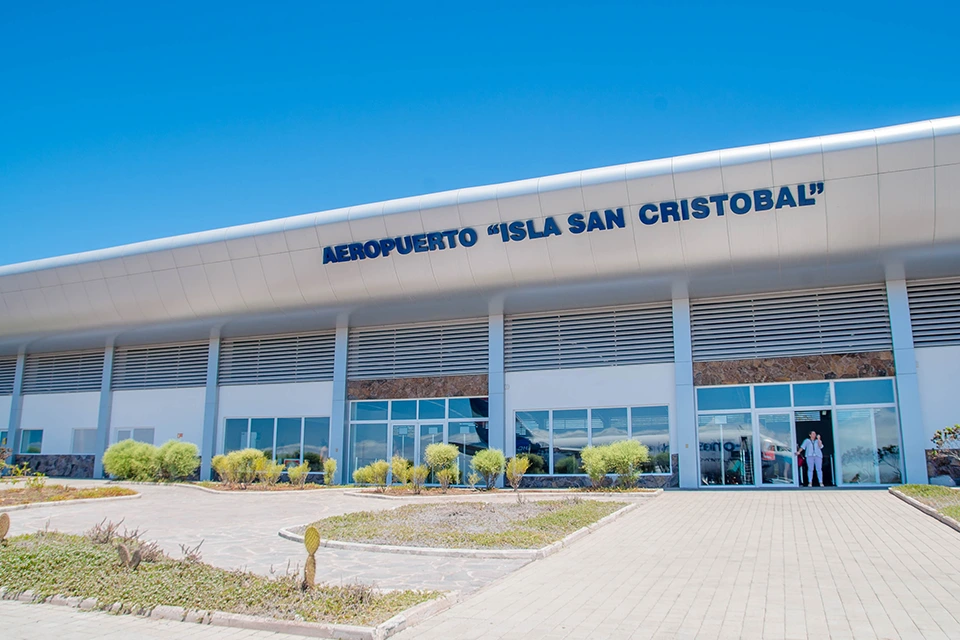
San Cristobal Airport (SCY) sits right on the edge of Puerto Baquerizo Moreno, the provincial capital, meaning you can walk from the terminal into town in a matter of minutes. It’s the better choice if your itinerary centers on San Cristobal itself, or if your cruise embarks from there rather than Baltra.
Perks of Booking Your Galapagos Trip with Metropolitan Touring
Traveling with an experienced operator takes most of the guesswork out of how to get to Galapagos. Metropolitan Touring handles flight coordination, mainland hotel stays, park fee logistics, and airport transfers as part of a seamless itinerary, so you’re not left piecing together connections on your own. Our naturalist guides and decades of on-the-ground experience in the islands also mean your time in the Galapagos is spent exploring rather than troubleshooting logistics — a meaningful difference on a trip where every day, and every permit, counts.
Departing From Galapagos Back to Ecuador
The return trip mirrors the arrival process: you’ll check in at the small Galapagos airport, pass through a security screening, and turn in your TCT card before boarding your flight back to Quito or Guayaquil. Keep in mind that flights out of the islands are almost always in the early afternoon, so plan your last morning accordingly — many visitors use it for one final short excursion before heading to the airport.
What Is the Best Way to Get to Galapagos?
There’s no single “best” way — it depends on your starting point, your budget, and how much of the planning you want to hand off. But for most travelers, the most reliable path is straightforward: fly into Quito or Guayaquil, spend the night on the mainland, and catch an early flight into either Seymour or San Cristobal the next morning. Whether you handle every leg yourself or let an operator like Metropolitan Touring manage it for you, understanding how to get to the Galapagos before you book will save you time, money, and a fair amount of stress once you’re actually on your way.