
Few destinations make travelers as aware of their presence as the Galapagos. Wildlife has evolved here in extraordinary isolation. Volcanic landscapes remain strikingly otherworldly. Encounters with giant tortoises, marine iguanas, sea lions, and blue-footed boobies can happen at remarkably close range. Yet the same qualities that make the archipelago so captivating also make thoughtful tourism essential.
Regenerative travel goes far beyond reducing the footprint of a vacation. It asks how tourism can actively contribute to the destination it depends upon. That means supporting conservation, strengthening the local economy, managing resources responsibly, and helping future generations understand why these islands are worth protecting.
Metropolitan Touring offers a model where experiencing the Galapagos and caring for it are closely connected — through managed visitor sites, small-ship expeditions, locally sourced food, environmental initiatives, and educational programs.
Quick takeaways:
- Conservation rules keep tourism within the destination’s limits.
- Small expedition ships create deeper, lighter-footprint encounters.
- Local sourcing keeps tourism value inside the islands.
- Education invests in the next generation of conservation leaders.

How Conservation Rules Safeguard the Galapagos
The Galapagos offers the world a powerful lesson: an extraordinary destination cannot absorb unlimited tourism without long-term consequences. Protecting fragile ecosystems requires clear boundaries, and the archipelago has built an extensive system to manage where visitors go and how they interact with the environment.
The Galapagos National Park designates authorized visitor sites across the archipelago — each with specific permitted activities — to distribute tourism and reduce pressure on the most sensitive environments.
Rules Every Traveler Should Know
Visitors are expected to follow strict guidelines designed to protect wildlife and habitats:
- Remain on designated trails at all times.
- Stay at least two meters away from all animals.
- Never feed or touch wildlife.
- Pass through biosecurity controls to prevent the introduction of invasive species.
Invasive species remain one of the greatest threats to isolated island ecosystems, so these entry checks matter as much as any rule on land.
Where Your Entry Fee Goes
Visiting the Galapagos comes with required fees that directly support the destination. The standard Galapagos National Park conservation entry fee for foreign visitors over age 12 is USD 200, with different rates for Ecuadorian residents, children, and visitors from CAN and Mercosur countries. Travelers must also pay the INGALA migration card fee of USD 20 per person. These fees help fund the management and conservation of one of the world’s most important protected ecosystems.
The scale of interest in the islands makes these measures all the more important. Preserving an ecosystem famous for its extraordinary wildlife requires tourism to operate within the limits of the destination — not the other way around.
Small Ships, Lighter Footprints: Metropolitan Touring’s Approach
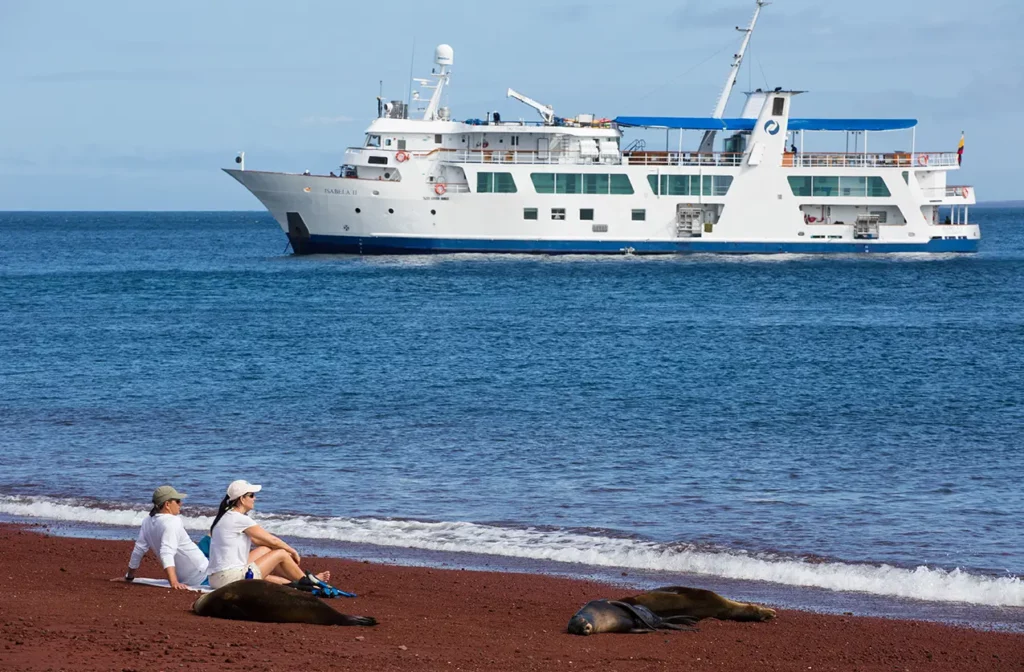
How travelers move through the Galapagos matters almost as much as where they go. Metropolitan Touring’s Yacht La Pinta and Yacht Isabela II intentionally keep guest numbers small. This creates a more intimate way to explore while limiting the size of groups arriving at sensitive visitor sites.
What Smaller Numbers Look Like
- Yacht La Pinta: a maximum of 48 guests, with excursions led by Galapagos National Park–certified Naturalist Guides.
- Yacht Isabela II: a smaller vessel designed for an equally personal expedition experience, also guided by certified Naturalist Guides.
- Certified expertise: all excursions across both yachts are led by Galapagos National Park–certified guides.
The result differs sharply from conventional large-ship cruising. Guides have more time to interpret what travelers are seeing, and wildlife encounters feel quieter and more personal.
Many Ways to Explore
Smaller numbers do not mean fewer experiences. Depending on the itinerary and location, days can include:
- Guided walks
- Snorkeling
- Kayaking and paddleboarding
- Panga rides
- Glass-bottom boat excursions
The focus is not on seeing as many islands as possible. It is on understanding the dramatic differences between them — from stark volcanic terrain and cactus-covered landscapes to marine environments teeming with life. Expeditions are designed around the Galapagos “Big 15”, a collection of the archipelago’s most iconic wildlife species. La Pinta’s itineraries, for example, offer the opportunity to encounter up to 14 of the 15 iconic species, helping guests understand their behavior, adaptations, and ecological significance.
Guides Who Turn Sightings into Understanding
Keeping groups small brings another advantage: time with the guides becomes part of the journey. A marine iguana basking on black lava is no longer just an unusual photo opportunity; it becomes a lesson in evolution. A bird nesting beside a trail becomes a chance to understand why keeping the proper distance matters. Education and exploration happen at once.
Comfort completes the picture. La Pinta offers spacious ocean-facing cabins and 24/7 medical assistance onboard, ensuring that responsible travel never feels restrictive. Comfort, discovery, and conservation integrate seamlessly when the experience is designed around the realities of the destination.
How Tourism Spending Supports Island Communities
For tourism to have a genuinely positive impact, some of the value visitors generate must stay in the communities where that impact occurs. In 2025, Metropolitan Touring made 40% of its food and provisioning purchases for Galapagos operations locally, meaning a meaningful share of the spending tied to feeding and supplying travelers circulates within the archipelago rather than leaving it immediately.
Local purchasing reaches well beyond an individual meal. It:
- Strengthens island supply chains.
- Supports local producers and entrepreneurs.
- Builds a direct relationship between tourism and island residents.
Metropolitan Touring also works with local businesses through supplier relationships and mentoring, turning purchasing decisions into opportunities for longer-term economic development. Protecting a destination becomes more durable when the people who live there can participate in — and benefit from — the economy built around its conservation.
Finch Bay Galapagos Hotel: Regenerative Living on Land
Regenerative travel does not stop when guests step off a yacht. On Santa Cruz Island, Finch Bay Galapagos Hotel brings the same principles into everyday operations, showing how decisions about food, water, and energy can collectively ease pressure on an island environment.

Food Grown and Sourced Close to Home
Around 40% of the ingredients used by the Finch Bay Galapagos Hotel restaurant are sourced on Santa Cruz Island. Fresh produce from the hotel’s own organic Chakrita garden complements these purchases. Growing and buying food closer to where it is consumed shortens supply chains and supports local production — especially meaningful in an archipelago located roughly 1,000 kilometers from mainland Ecuador.
Water That Works Twice
Freshwater is precious on these islands. The hotel runs its own advanced domestic wastewater-treatment system, using microorganisms to break down organic matter. Rather than discarding the treated water, it recirculates the supply to irrigate plants — a practical loop where water is cleaned to required standards and reused instead of wasted.
Energy From the Sun
By 2025, solar energy accounted for 39% of the hotel’s energy use, while overall emissions dropped by more than 15%. These figures turn the idea of “eco-friendly accommodation” into something concrete and measurable. Finch Bay Galapagos Hotel offers a natural counterpoint to the expedition at sea: guests can spend their days exploring giant tortoise habitats, snorkeling, or visiting protected sites, then return to a hotel where regenerative thinking continues quietly behind the scenes. Regeneration, in other words, is not a single project; it is the sum of countless decisions made every day.
Why Education Sits at the Heart of Regenerative Travel
Some of the most valuable results of regenerative tourism cannot be measured in hectares protected, emissions reduced, or dollars spent locally. Education can shape outcomes that last for decades. For young people growing up in the Galapagos, understanding their extraordinary surroundings can influence how they view conservation, tourism, and their own future on the islands, and Metropolitan Touring’s Educación a Bordo program was built around exactly that idea.

Educación a Bordo: Inspiring the Next Generation
For more than two decades, Educación a Bordo has invited young Galapagos residents aboard Metropolitan Touring’s expedition vessels to experience the archipelago from a perspective few had accessed before. To date, 1,785 Galapagos students have taken part, deepening their appreciation for the islands they call home.
That reach matters. Living in the Galapagos does not automatically mean the chance to visit its protected areas or see the islands the way visitors do. Bringing local students aboard gives them opportunities to:
- Learn about the remarkable ecosystems in their own backyard.
- Interact directly with guides and educators.
- Experience firsthand why conservation matters.
The cumulative effect is significant. A student who learns to see the archipelago through the lens of ecology today could become tomorrow’s naturalist, scientist, entrepreneur, park ranger, tourism professional — or simply a resident deeply invested in protecting home. Lasting conservation depends on people who understand the value of what is being protected, which is why education belongs at the center of regenerative tourism.
Travel That Leaves the Galapagos Stronger
The Galapagos have never been an ordinary destination. Their extraordinary wildlife, dramatic volcanic landscapes, and critical role in our understanding of evolution have made them one of the most recognizable natural places on Earth. That fame carries responsibility: tourism must contribute to the future of the archipelago rather than simply consume the experience it offers.
Metropolitan Touring’s approach shows how that responsibility can extend throughout a journey:
- Aboard La Pinta and Isabela II, certified Naturalist Guides transform wildlife sightings into opportunities for understanding.
- Local purchasing keeps 40% of food and provisioning spending within the islands.
- At Finch Bay Galapagos Hotel, an organic garden, local sourcing, wastewater treatment, and solar energy bring responsibility into daily operations.
- Through Educación a Bordo, the benefits of tourism reach 1,785 young Galapagos residents — and counting — who may become the islands’ next conservation leaders.
None of these measures suggests that travel has no footprint. It does. The more meaningful question is whether that footprint is accompanied by something positive and lasting. A journey to the Galapagos can certainly leave travelers changed. The greater ambition of regenerative travel is to make sure the destination has something to gain from the journey, too — so that long after visitors return home, these extraordinary islands remain wild, resilient, and full of life. Ready to explore the Galapagos the regenerative way? Plan your journey with a Metropolitan Touring Destination Expert.


